

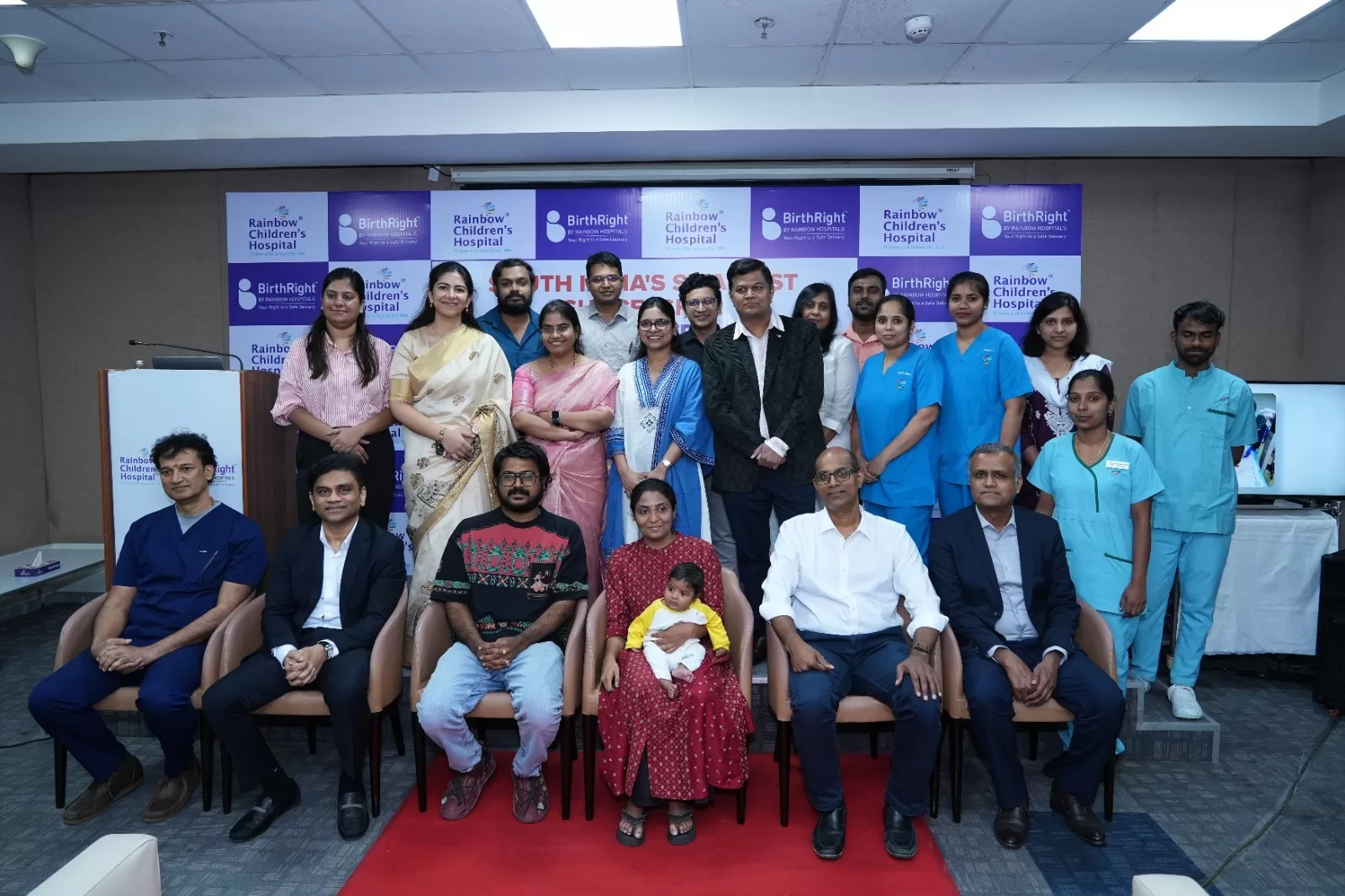
Doctors at Rainbow Children’s Hospital, Banjara Hills, have achieved a landmark in pediatric care. They completed a successful living-donor liver transplant on a six-week-old baby weighing just 2.9 kilograms. This is a historic South India’s smallest baby liver transplant. The baby’s mother donated a 62-gram liver graft. After a complex recovery, the baby went home breathing without oxygen, taking full feeds by mouth, with the new liver working well.
Rapid Liver Failure in a Newborn
The baby developed jaundice in the first week of life. By three weeks, he had severe liver failure.
The Pediatric Gastroenterology and Hepatology team acted quickly. They ruled out infections, metabolic disorders and genetic causes. The team then suspected Gestational Alloimmune Liver Disease (GALD), a rare condition.
Intravenous immunoglobulin and two exchange transfusions did not stop the decline. As a result, the team moved to liver transplantation.
What Is GALD?
GALD is a rare condition that causes rapidly worsening liver failure in newborns. Early diagnosis matters because the disease can progress within days.
A Highly Complex Transplant Surgery
At 2.9 kilograms, the baby had extremely small blood vessels. His abdomen also had very little space.
The surgical team reduced the mother’s liver graft to 62 grams to match his body size. They then connected the tiny arteries and veins and positioned the graft safely. This demanded exceptional precision and deep expertise in pediatric liver transplantation. The transplant was completed successfully.
Doctors’ Perspective
Dr. Prashant Bachina, Pediatric Gastroenterologist and Hepatologist, said early diagnosis and timely transplantation can decide whether a newborn with fast-worsening liver failure survives. He added that a specialised pediatric centre with all the required expertise under one roof makes this possible. He also stressed that recovery needed close monitoring, nutritional support and quick management of complications.
Dr. Srinivas Reddy Mettu, Pediatric Liver Transplant Surgery, described the procedure as highly complex at this body size. He pointed to the tiny blood vessels and limited abdominal space. He said safe graft placement needed meticulous planning, fine surgical skill and close teamwork.
A Challenging Recovery After Surgery
The post-operative period was just as demanding. The baby faced several serious complications:
- Severe lung problems: He needed advanced breathing support, including high-frequency oscillatory ventilation and inhaled nitric oxide. Doctors also used bronchoscopy to clear secretions and treat areas of lung collapse.
- Resistant infections: He developed serious infections caused by bacteria resistant to several antibiotics.
- Intestinal leak: A leak developed near a surgical join in his intestine. This led to a second surgery and temporary stomas, which are openings on the abdomen that let the bowel rest and heal.
He received prolonged intravenous nutrition. Doctors then restarted oral feeds gradually, under close monitoring, until he could take full feeds by mouth.
The Multidisciplinary Team Behind the Recovery
The outcome came from close coordination across many teams:
- Pediatric Gastroenterology and Hepatology
- Pediatric Liver Transplant Surgery
- Pediatric Anesthesia
- Pediatric and Neonatal Intensive Care
- Pediatric Surgery and Radiology
- Nutrition and Physiotherapy
- Infection Control
- Transplant-trained nursing staff, fellows and transplant coordinators
The hospital’s dedicated Pediatric Liver Transplant Intensive Care Unit supported the team throughout.
Rainbow’s Pediatric Liver Transplant Programme
Rainbow Children’s Hospital runs one of India’s leading pediatric liver transplant programmes. Its centres in Hyderabad, Chennai and Bengaluru have together completed 107 pediatric liver transplants, with an overall survival of 95%. The programme combines transplant surgery, pediatric hepatology, intensive care, nutrition, infection management and rehabilitation under one specialised team.
About Rainbow Children’s Medicare Limited
Rainbow Children’s Medicare Limited runs 26 hospitals, 6 OP clinics and 2 dedicated IVF clinics across 11 cities, with 2,565 beds in total. Its pediatric services operate under “Rainbow Children’s Hospital”. Its women’s care services operate under “Birthright by Rainbow”. The group follows a hub-and-spoke model and a full-time, consultant-led doctor engagement model. It also runs the country’s largest pediatric DNB training programme in private healthcare.
For more information, visit Rainbow Hospitals