
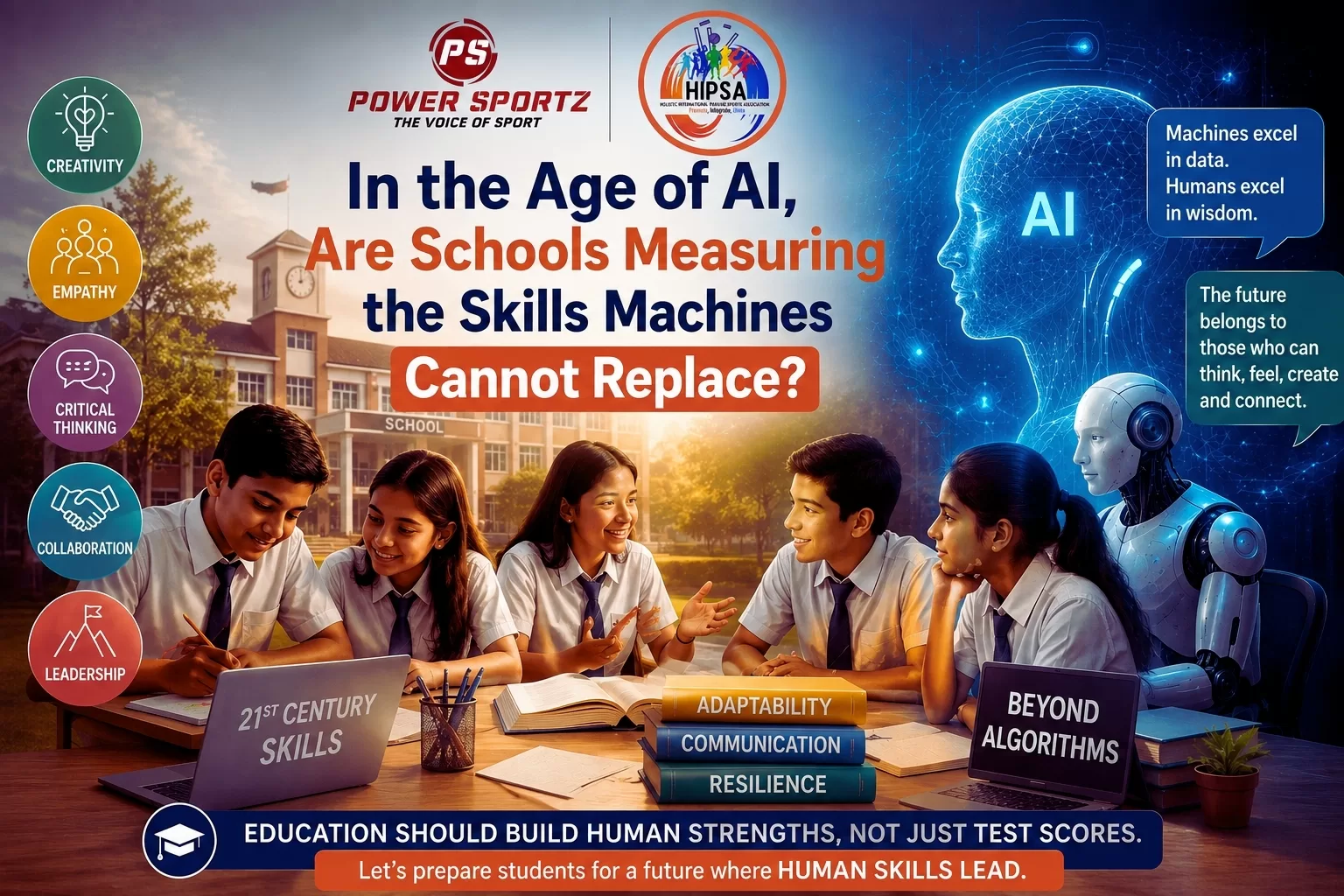
AI in education is changing classrooms faster than ever, raising an important question: are schools still measuring the human skills machines cannot replicate? The Sports Life Skills Framework, developed in India, offers one answer — using sport as a structured environment to build and track these capabilities.
In this article, you’ll learn why human skills matter more as AI in education grows, how this framework works, and why Hyderabad has become its first testing ground.
The Paradox of AI in Education
AI can now generate explanations, summarise information, and answer complex questions within seconds. As a result, schools are increasingly preparing children for a world where AI is embedded in daily life and work.
India’s education system is responding too. CBSE introduced Computational Thinking and Artificial Intelligence for Classes III to VIII starting the 2026–27 academic session, with a focus on reasoning, problem-solving, and ethical use, not just technical skill.
However, this shift creates an interesting paradox. As machines become more capable, distinctly human capabilities may become more valuable, not less. AI can generate an answer, but it cannot judge whether that answer deserves trust. AI can propose a solution, but it cannot decide which one is responsible.
Why “Future-Ready” Needs a New Definition
The phrase “future-ready education” is often linked to coding, robotics, and digital literacy. These skills matter. But technology access alone cannot make a child future-ready.
As AI tools become widely accessible, knowing how to retrieve information may no longer be the differentiator it once was. Instead, the ability to interpret information, question it, and act responsibly is becoming more valuable.
This shifts focus toward a different skill set:
- Decision-making
- Resilience
- Adaptability
- Communication
- Teamwork
- Leadership
- Responsible citizenship
Therefore, these so-called “soft skills” may no longer deserve that label. They determine how a person acts when information is incomplete or circumstances change — and unlike AI tools, they cannot simply be downloaded on demand.
Sport as a Laboratory for Human Skills
Interestingly, schools may already have one of the most effective environments for developing these skills: the playing field.
Consider a few common sporting moments. A missed penalty becomes a lesson in emotional regulation. A mid-match strategy change requires real-time judgement. A disagreement between teammates turns communication into a practical skill, not an abstract concept.
Sport repeatedly places children in situations where:
- There is no “generate answer” button
- Decisions must be made under pressure
- Consequences must be managed
- Collaboration determines outcomes
As a result, sport can function as far more than physical activity — it becomes a training ground for real human behaviour.
The Missing Piece: Are Schools Capturing This Learning?
A child may play sport for seven years of schooling. By the end, most schools can document tournaments played, medals won, and attendance. However, they typically cannot show how that child developed as a person through sport—specifically whether they built resilience, matured in their decision-making, or grew into a stronger collaborator. In short, schools have historically assumed these outcomes happen naturally, but incidental development and structured development are not the same thing.
From Holistic Education to Evidenced Holistic Education
This gap becomes especially relevant under India’s National Education Policy (NEP) 2020, which emphasizes experiential learning, competency-based education, and sports-integrated learning.
Academic education follows a clear structure: a concept is introduced, applied, assessed, and recorded. Life-skills development has rarely followed the same rigor. This is the gap the Sports Life Skills Framework was built to address.
What Is the Sports Life Skills Framework?
Developed through Power Sportz Academy in partnership with the Holistic International Pravasi Sports Association (HIPSA), the Sports Life Skills Framework is designed for students from Classes 6 to 12.
Its core idea is simple: schools don’t need another activity. They need to extract more educational value from the activities children already do.
Framework structure at a glance:
- 7 age-progressive levels
- 42 structured modules
- 168 micro life skills
- Core competencies: decision-making, resilience, adaptability, communication, teamwork, and leadership
Furthermore, the framework doesn’t stop at identifying a skill. Students are guided to recognize how a skill shows up in sport, reflect on how they used it, and transfer that learning beyond the playing field — for example, applying resilience learned from a sporting loss to an academic setback.
How the Framework Measures Behaviour Responsibly
A natural question follows: can something like resilience or leadership actually be measured? Not in the same way as multiplication tables — and it shouldn’t be.
Because life skills are behavioural, their assessment focuses on situations, choices, reasoning, and reflection rather than factual recall. Importantly, the goal isn’t to label a child or reduce personality to a score. Instead, it’s to make development visible over time.
The framework also includes teacher professional development, since structured life-skills education requires educators trained to recognize and reinforce these competencies consistently.
Accreditation highlights:
- The student framework is accredited by The CPD Group, UK
- The Teacher Professional Development Programme is accredited by The CPD Certification Service, UK
Why Hyderabad Is the First Rollout City
Initial implementation of the Sports Life Skills Framework has begun in Hyderabad schools, ahead of a broader national rollout. This choice isn’t incidental.
Hyderabad combines established school groups, strong technology awareness, and a growing focus on student wellbeing and future readiness. Additionally, the city sits at the intersection of education and one of India’s most prominent technology ecosystems, making it a natural place to explore this question in depth.
Why AI Makes Life Skills More Valuable, Not Less
It’s tempting to view technology skills and human skills as competing priorities. They aren’t. Students will need both.
A student who understands AI but lacks judgement can misuse powerful technology. Likewise, a technically skilled employee who cannot collaborate or recover from failure may struggle in a dynamic workplace. Consequently, the arrival of AI shouldn’t reduce attention to life skills — it may be a reason to increase it.
As Dr. Kanthi D. Suresh, President of HIPSA, explains, AI is changing what children can access and accomplish, but children will still need to decide, adapt, collaborate, lead, and recover from setbacks. According to her, sport gives schools a powerful real-world environment for developing these capabilities intentionally, measurably, and visibly.
The Report Card of the Future
Imagine a student profile for 2035. Will parents, universities, and employers be satisfied knowing only exam performance? Or will they increasingly expect evidence of how a student thinks, adapts, and collaborates?
A traditional report card answers one question: what does this student know? The future student profile may need to answer another: what can this student do with what they know, especially under pressure?
The rise of AI in education reflects a broader shift in how schools may need to evolve. As machines take over more information-based tasks, the human capabilities that remain distinctly ours — judgement, resilience, communication, and leadership — become more valuable, not less. The Sports Life Skills Framework offers one practical model for keeping pace with that shift.
With its structured, age-progressive approach and early rollout in Hyderabad, this framework offers schools a practical way to move from simply providing experiences to evidencing what students actually develop through them.
Interested in bringing structured life-skills education to your school? Reach out to Power Sportz Academy or HIPSA to learn more about implementing the Sports Life Skills Framework.