

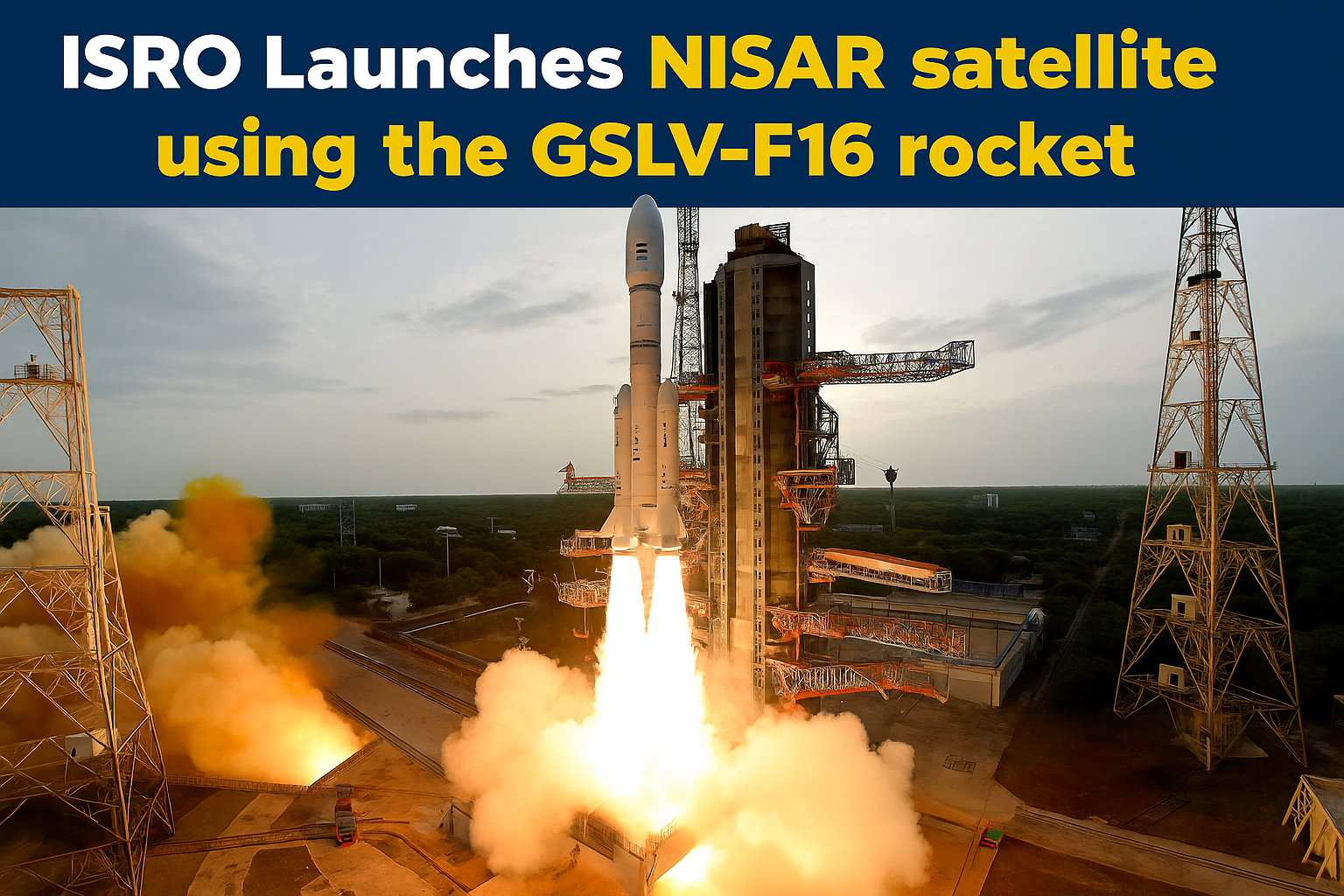
In a groundbreaking development for global space collaboration and Earth science, India and the United States have successfully launched the NISAR satellite — a joint mission developed by NASA and ISRO (Indian Space Research Organisation).
The satellite lifted off from Satish Dhawan Space Centre in Andhra Pradesh at 5:40 PM IST on Wednesday aboard ISRO’s GSLV rocket. Just 20 minutes after launch, ISRO confirmed successful communication with the satellite, which is now fully operational in orbit.
A Giant Leap in Earth Observation
NISAR (NASA-ISRO Synthetic Aperture Radar) carries a highly advanced radar system that can deliver detailed, 3D views of Earth’s surface. What sets it apart? It’s the first satellite ever to carry both L-band (NASA) and S-band (ISRO) radar systems on one platform.
These radars can track even the smallest shifts as little as one centimeter in land, ice, or water surfaces. From 747 kilometers above the Earth, NISAR will capture high-resolution images through clouds, darkness, and any weather condition.
The mission has real-world impact for people across the globe. Here’s what it can help with:
- Natural Disaster Response: Detects early signs of earthquakes, landslides, floods, and volcanic activity.
- Agriculture: Tracks crop growth, soil moisture, and irrigation patterns to support farmers and food security.
- Climate Change Monitoring: Measures glacial retreat, melting ice, and wetland changes to better understand climate shifts.
- Infrastructure Safety: Monitors roads, bridges, and dams for ground movements that may pose safety risks.
A Vision from the Ground Up
The idea for NISAR was born over a decade ago. Speaking after the launch, ISRO Chairman V. Narayanan expressed pride:
“This is the GSLV’s first mission to a sun-synchronous polar orbit, and with this launch, we begin a new chapter in Earth observation.”
NASA’s Nicky Fox, Associate Administrator for Science, added: “Where moments are critical, NISAR will provide data to help protect lives and infrastructure — this is science working for the people.”
First-of-its-Kind Technology
NISAR is the first free-flying satellite to include both L-band and S-band radars. Each radar type helps track different kinds of data:
- L-band (NASA): Ideal for measuring forest density, glacier movement, and subtle ground motion.
- S-band (ISRO): Suited for monitoring crops, grasslands, and urban structures.
The 12-meter deployable radar antenna will scan nearly the entire Earth every 12 days, offering unprecedented coverage.
The mission is a 50-50 collaboration between NASA and ISRO, with components built in both the US and India:
- NASA contributed: L-band radar, antenna system, GPS units, and communication equipment.
- ISRO delivered: S-band radar, spacecraft bus, and launch vehicle.
India’s U R Rao Satellite Centre managed the spacecraft construction. National Remote Sensing Centre, Hyderabad, will handle the satellite’s data reception and distribution.
What’s Next?
The satellite will now enter a 90-day commissioning phase, during which its massive radar antenna will be deployed. Data from NISAR will be available globally, giving scientists, disaster response teams, and environmental planners a powerful new tool.