

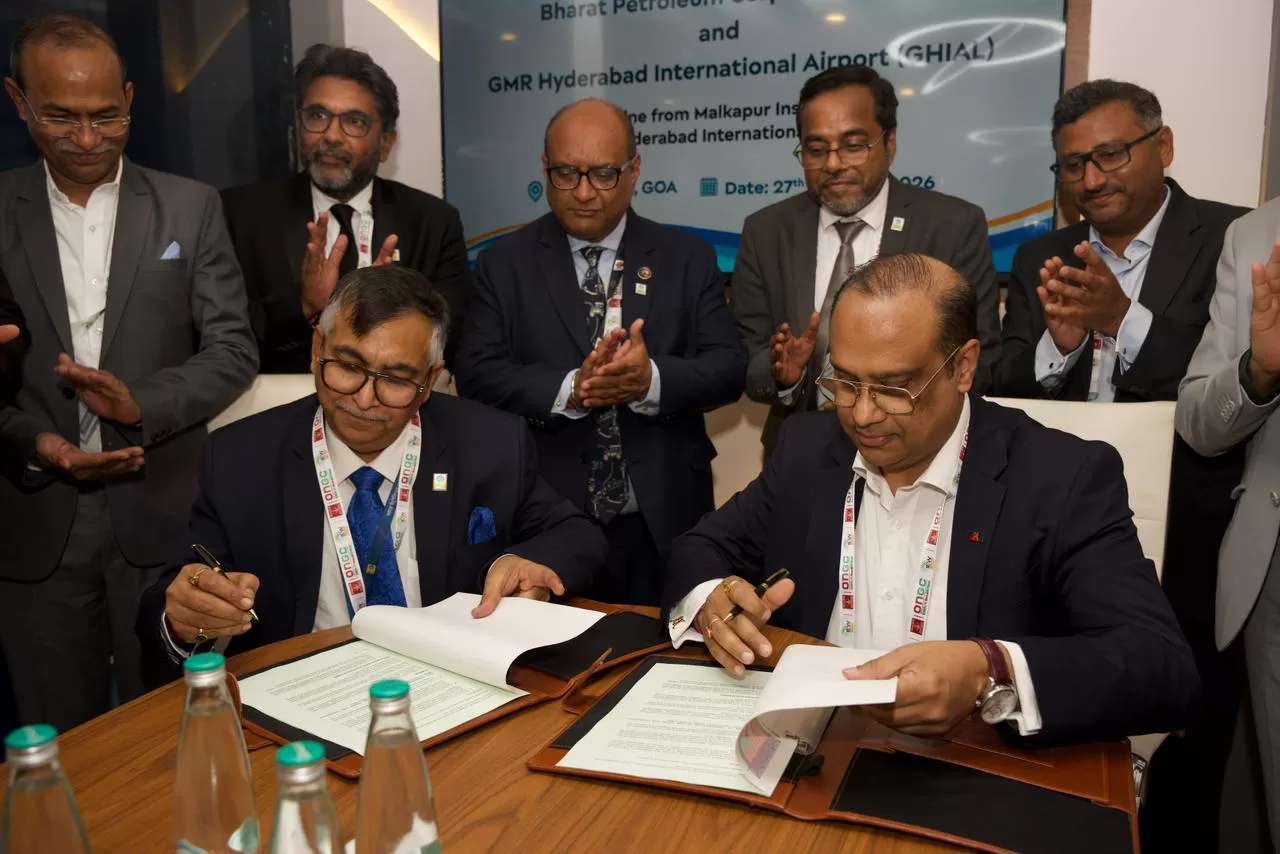
Bharat Petroleum Corporation Limited (BPCL) has taken an important step to support India’s fast-growing aviation sector. The company has signed an agreement to build a dedicated Aviation Turbine Fuel (ATF) pipeline for Hyderabad Airport.
This project will connect BPCL’s Malkapur Installation to the fuel farm at GMR Hyderabad International Airport Limited (GHIAL). As a result, the airport will receive a steady and reliable supply of aviation fuel in a safer and cleaner way.
Agreement Marks a Strategic Partnership
BPCL and GHIAL signed the agreement on January 27, 2026. Shri Sujit Kumar, Chief General Manager – Marketing (Aviation), BPCL, and Mr. Ashish Kumar, Chief Commercial Officer, GHIAL, signed the agreement.
Through this partnership, both organisations aim to improve fuel supply efficiency. Moreover, the project supports long-term planning for airport expansion and rising air traffic.
Reducing Emissions and Improving Safety
Speaking about the project, Shri Sanjeev Kumar, Business Head – Aviation at BPCL, said the company has supported Indian airports since the early days of aviation growth. He explained that the new ATF pipeline will reduce fuel transport by road. Therefore, it will lower carbon emissions and improve overall safety.
In addition, fewer fuel tank lorries on roads will reduce traffic and accident risks. As a result, fuel delivery will become faster, smoother, and more dependable.
Supporting Sustainable Airport Operations
Mr. Pradeep Panicker, Chief Executive Officer of GHIAL, welcomed the collaboration. He said the project supports the airport’s focus on cost control and sustainability. Furthermore, the pipeline will improve daily operations and help reduce the airport’s carbon footprint.
According to him, such projects are necessary today, especially as airports work toward greener and more efficient systems.
Pipeline Details and Operational Benefits
The BPCL ATF pipeline for Hyderabad Airport will stretch over 56 kilometres, including about one kilometre inside the airport area. Once operational, the pipeline will work as a common carrier system. This will allow smooth and continuous fuel supply to airlines.
Meanwhile, BPCL expects the pipeline to improve efficiency, safety, and environmental performance. Overall, the project reflects BPCL’s strong commitment to building modern and future-ready energy infrastructure for India’s aviation industry.